
OUR STORY
A Dream Carried Across Continents
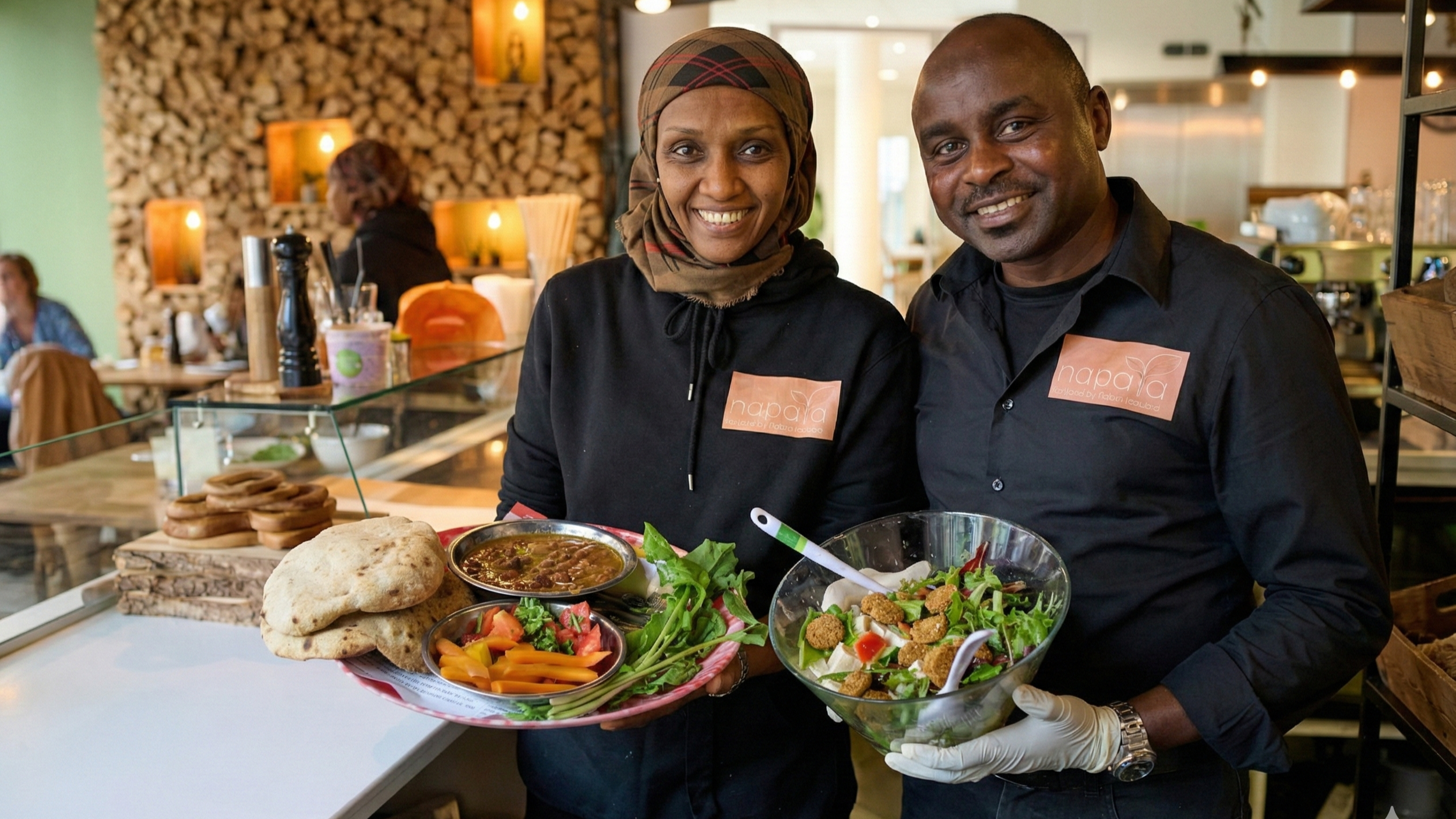
Before Napata was a restaurant, it was a longing. A longing for the taste of home, for the warmth of a table where everyone belongs, for the fragrant steam rising from a pot of mulah that has simmered for hours with love as its first ingredient. Ranya and Abdelrahman Adam did not set out to make history when they opened the first Sudanese restaurant in the Netherlands. They set out to share something precious: the culinary soul of an ancient civilization, and the boundless hospitality that runs through Sudanese blood like the Nile runs through their homeland.
Theirs is not simply a story of arrival. It is a story of creation against all odds, of building when circumstances demanded they rebuild, and of choosing love as their compass when the path forward was unclear. It is the story of two remarkable people who decided that the best way to honour their heritage was to invite the world to their table.
Two Souls, One Vision
Abdelrahman came to his calling through many doors. A journalist by training, a humanitarian by conviction, and an advocate for peace by necessity, he spent years working to uplift communities and amplify voices that struggled to be heard. His path was not easy, and the cost of speaking truth was high. Yet through every chapter of his life, one thing remained constant: his belief that something good can always emerge from struggle.
Ranya is an artist whose canvas became the kitchen. Her creativity flows through every dish she prepares, transforming recipes passed down through generations into experiences that guests describe as transcendent. She sees cooking as an act of love, and her food carries the tenderness of a mother feeding her children, the precision of a craftsperson perfecting her art, and the generosity of a host who would never let anyone leave her table hungry.
Together, they form a partnership that is both deeply romantic and profoundly practical. He dreams and builds. She creates and nourishes. And between them, they have conjured something that neither could have achieved alone.
Building Through the Storm
The journey to Napata wound through unexpected valleys. When Ranya and Abdelrahman first began cooking professionally in the Netherlands, they launched a catering business that quickly earned devoted customers. Then the pandemic arrived, and like so many small ventures, theirs was brought to its knees. They found themselves exhausted, with debts accumulating and dreams that seemed to slip further away with each passing month.
But the universe, as Abdelrahman would say, has a way of providing.
A dear friend named Nils de Witte operated a creative workspace called Graduate Space in Utrecht. When the restaurant space beneath it became available in 2022, Nils extended his hand. More than his hand, in truth: he extended his faith. He helped them acquire plates and cutlery. He supported them financially during the very period when they owed him money. He believed in their vision when belief was the scarcest resource of all.
Abdelrahman speaks of this generosity with eyes that still hold wonder. The restaurant, he says simply, exists because of Nils. This is the Sudanese way, perhaps: to acknowledge that our achievements are never truly our own, but are built upon the kindness of those who chose to lift us.
Napata: Where Ancient Heritage Lives
The name Napata reaches back through millennia to the capital of Kush, the ancient Nubian kingdom that flourished along the upper Nile when the pyramids were still young. It was a place of learning, of trade, of civilization at its most refined. To name their restaurant Napata was to claim this legacy, to declare that Sudanese culture stands among the great traditions of human history.
There is another meaning, too. In Sudanese, "napata" means a small plant, a seedling. And truly, this restaurant began as precisely that: something fragile and hopeful, pushing up through difficult soil toward the light.
What has grown from that seedling now draws guests from across the Netherlands and beyond. The Beste Nieuwkomer award, received at the Melkweg in Amsterdam, brought tears of recognition. Not because prizes were ever the goal, but because the award affirmed what Ranya and Abdelrahman had dared to believe: that Sudanese cuisine belongs on the richly set table of global gastronomy, that their plate too deserves its place among the traditions that have found home in the Netherlands.
The Table Where Nobody Eats Alone
In Sudan, there is a saying that has guided families for generations: the tastiest food is the food where many hands have touched it. This is not merely poetry. It describes how Sudanese people actually eat, gathered around large platters from which everyone shares, conversation flowing as freely as the karkade in their glasses.
At Napata, solo diners often find themselves gently invited to join other tables. This is not performance; it is reflex. In Sudanese culture, the idea of eating alone in a restaurant is almost bewildering. Why would you not share this moment? Why would you sit in silence when friendship waits just one chair away?
The dishes themselves carry this philosophy. The slow-cooked mulah, fragrant with cardamom and coriander, is meant to be passed and savoured. The fresh kisra bread is meant to be torn and dipped together. The cool hibiscus karkade that has refreshed travellers along the Nile for thousands of years is meant to prompt conversation, to ease the heart, to welcome the stranger.
Sudanese falafel arrives differently here than guests might expect from Middle Eastern versions. Black beans and dill create a distinctive flavour, and the texture is crunchier, more satisfying. Aubergine dishes speak of centuries of culinary refinement. Weekend specials bring forth lamb and chicken and okra, prepared as Ranya's family has prepared them for generations.
More Than a Restaurant
Napata has become what its founders always hoped it might be: a cultural connection point for Sudanese people across the diaspora, and a doorway for Dutch guests into one of Africa's oldest and most remarkable civilizations. The Friday evening live music gatherings fill the space with sound and laughter. Cultural events draw curious newcomers alongside homesick Sudanese who simply need to be surrounded by familiar flavours and familiar warmth.
The community that has formed around this restaurant continues to grow. Guests who arrived as strangers have become regulars, then friends, then family. The walls hold photographs and art that tell the story of a proud nation. The kitchen holds recipes that Ranya guards like the treasures they are.
And always, always, there is welcome. This is perhaps the simplest and most profound thing Napata offers: the assurance that you belong here. That your presence at this table is wanted and celebrated. That the warmth you feel is genuine, and it is yours to take with you when you leave.
The Plates We Place on the Table
When Abdelrahman accepted the Beste Nieuwkomer award, he spoke of the Dutch table: already richly set with cuisines from every corner of the world. Ethiopian and Eritrean, Indonesian and Surinamese, Turkish and Moroccan. Each tradition has earned its place through years of sharing and adapting and becoming part of the national palate.
Now, finally, the Sudanese plate sits among them.
This is not a small thing. It is not a small thing for a country with Sudan's ancient heritage to be represented at last. It is not a small thing for the flavours that Ranya and Abdelrahman's mothers taught them to prepare to now delight strangers who have become friends. It is not a small thing to hear Dutch guests, after their first taste of mulah, declare that they will return again and again.
The dream continues to unfold. There is talk of a second location, perhaps in Amsterdam, to share Sudanese cuisine with even more of the Netherlands. There are plans to expand, to teach, to welcome ever more guests into this extraordinary tradition.
But for now, there is today. There is the next pot of stew to prepare, the next batch of kisra to bake, the next guest to greet with genuine warmth. There is the simple, profound work of feeding people with love.
Welcome to Napata. Welcome to our table. Welcome home.
A Family United
Napata is, in every sense, a family affair. On weekends, you will often find all three of Ranya and Abdelrahman's children helping out: greeting guests, clearing tables, learning the rhythms of hospitality that their parents have made their life's work. This is how they were raised. In Sudan, children grow up watching their elders cook and host and welcome, and when the time comes, they step naturally into those same roles. The Adam children are no different.
Mohamed, the eldest at seventeen, carries his father's fire. He has inherited Abdelrahman's passion for justice, his instinct to speak for those who cannot speak for themselves. He is considering a future in law, a path that would honour the advocacy his father has practiced throughout his life. When he helps at the restaurant, there is a quiet seriousness to him, a young man already thinking about the world he wants to help build.
Nedhal, at fifteen, is the heart of the family. Sweet-natured and steady, she is the one who holds everyone together, the glue that binds siblings and parents alike. Her warmth is immediately felt by guests, and her presence behind the counter brings a gentleness that perfectly complements her mother's nurturing spirit in the kitchen.
Ashraf, now thirteen, is the budding entrepreneur of the family. He was born in Khartoum and came to the Netherlands when he was only two, yet Sudan lives in his heart as vividly as it does in his parents'. He watches, he learns, he already thinks about what might be possible. When he helps on Saturdays, you can see the wheels turning: a young mind absorbing not just how to run a restaurant, but how to build something meaningful from nothing.
The war that erupted in Sudan in April 2023 brought fresh anguish to the family, as it has to every Sudanese person scattered across the diaspora. But the Adams responded in the way they know best: by building, by gathering, by turning their restaurant into a space for community action. Fundraising events bring Sudanese and Dutch neighbours together in solidarity. Flyers for aid organisations sit on every table. The message is clear: we mourn, but we do not stop. We grieve, but we also work.
Abdelrahman has articulated this philosophy with words that deserve to be remembered: while others destroy, we try to build. Love is the driving force.
And so the next generation watches and learns. Three children growing up in the Netherlands, rooted in Sudanese values, shaped by parents who have shown them that resilience and love can build something beautiful even in the hardest of times. Napata is their inheritance, not merely as a business, but as a lesson in what it means to welcome others, to honour your heritage, and to never stop building.
“While they destroy, we try to build. Love is the driving force.”